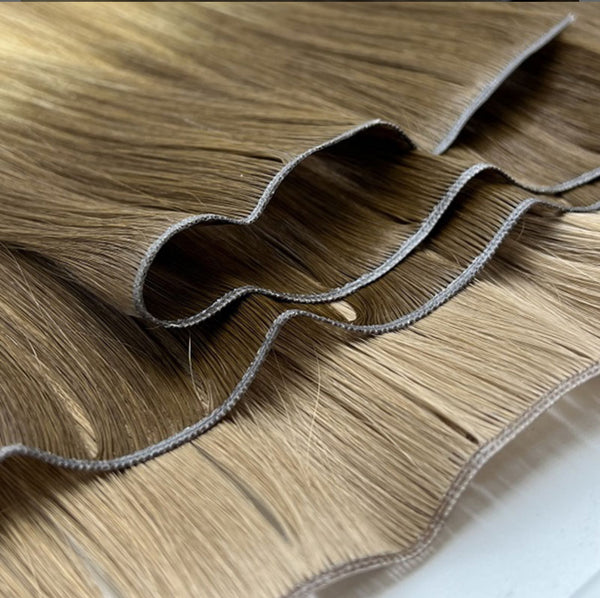

What Makes a Genius Weft Different?
The name "Genius Weft" refers to a specific construction method, not a brand. Understanding what it actually means, technically, helps explain why the result looks and feels different from other weft systems and why it performs particularly well for clients with fine or thin hair.
A traditional machine weft is sewn using an industrial process that produces a thick, reinforced fabric track, typically 1.5–3mm thick.
That bulk creates a visible ridge under fine or straight hair and concentrates tension at the attachment point.
A hand-tied weft reduces this bulk considerably, but introduces two limitations: the hand-knotting process produces small stray hairs at the seam (known as "return hair" or a "hair beard") that can cause scalp irritation, and the weft cannot be cut without unraveling, making custom-fit placement difficult.
Genius Weft solves both of these problems simultaneously. The construction uses a precision machine-sewn spine bonded with polyurethane (PU) resin, which achieves a weft thickness of approximately 0.5–0.7mm. That's thinner than both hand-tied and traditional machine wefts.
The PU-sealed edge means the weft can be cut at any point without shedding or unraveling, giving your stylist the freedom to customise the length and fit precisely to your head shape and hair distribution. And because the construction eliminates return hair entirely, there are no stray fibres at the seam to irritate the scalp.
The result of this construction is a weft that lies completely flat against the scalp, virtually undetectable even in ponytails, updos, and sleek styles.
It also delivers higher hair density per row than hand-tied alternatives. More volume, less bulk, and a more discreet finish.
Genius Weft combines the ultra-thin, flat profile of hand-tied wefts with the durability and cut-anywhere flexibility of machine construction, making it the most versatile and discreet weft system currently available.